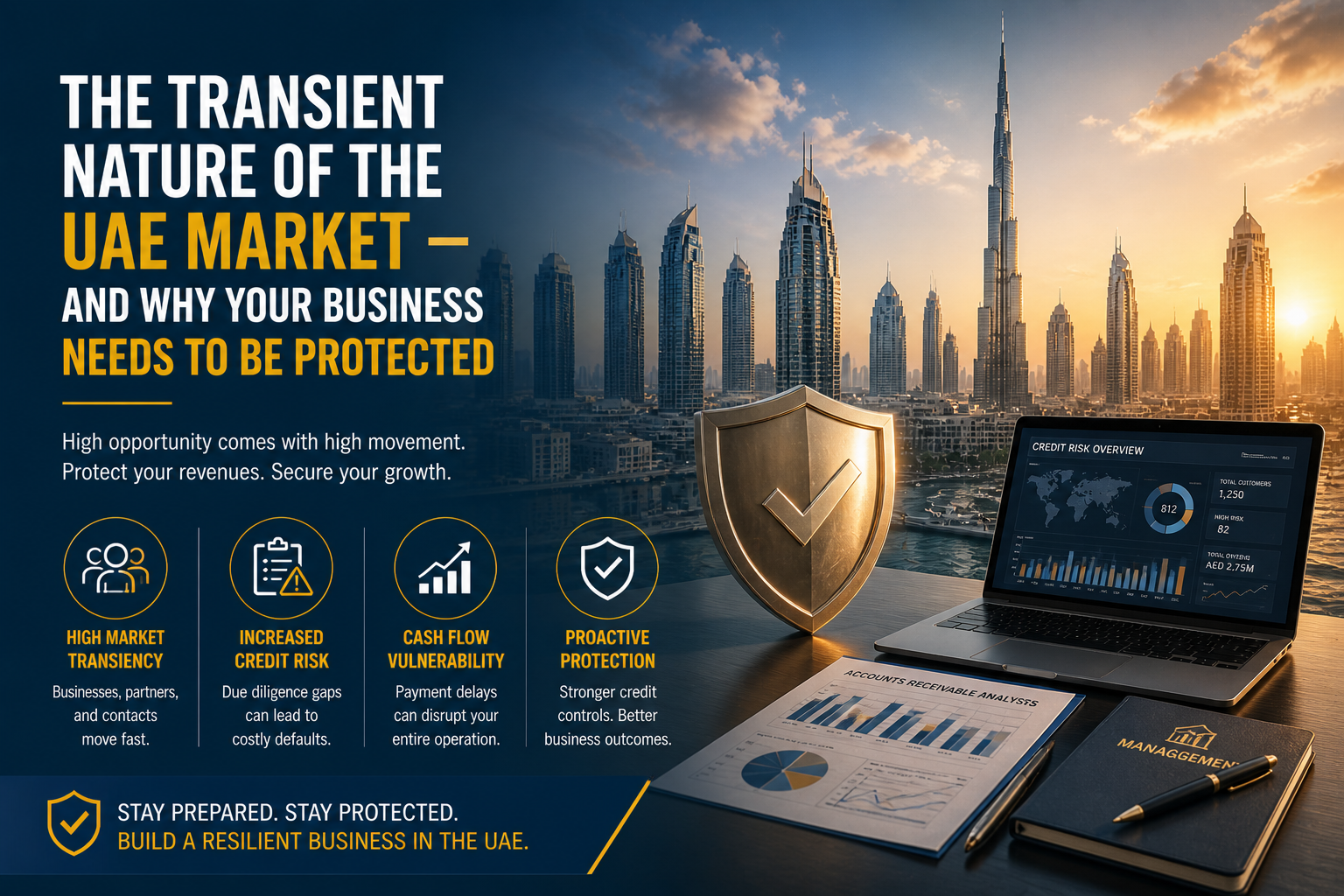
The UAE is one of the most dynamic business environments in the world. Its openness, its tax advantages, and its position as a regional hub attract entrepreneurs, traders and professionals from every corner of the globe. That diversity is one of its greatest strengths.
But it also creates a unique vulnerability that every business operating here should understand.
Unlike more established markets where companies and their principals have deep roots, long histories and reputational accountability built over decades, the UAE market is highly transient by nature. People arrive, set up quickly, trade — and sometimes leave just as quickly. For the majority, this reflects nothing more than the realities of expat business life. But for a small number, that transience is not incidental. It is deliberate.
A Problem That Is More Common Than People Admit
In my years working across credit risk and debt collection in the GCC, I have encountered a pattern that businesses rarely talk about openly — the premeditated fraudster.
This is not the customer who genuinely struggles to pay due to cashflow difficulties or market conditions. That situation, while frustrating, is a normal part of business life and can often be managed. The more concerning profile is the individual or entity that arrives in the market with no intention of honouring their obligations from the outset — obtaining goods, services or credit facilities, and then disappearing before accountability catches up with them.
The transient nature of the UAE makes this easier to execute than in most markets. Company formation is relatively straightforward. Individuals move between jurisdictions. And by the time the warning signs become obvious, the window to act has often already closed.
Why Traditional Due Diligence Is Not Always Enough
Many businesses rely on a basic level of due diligence before extending credit — a trade licence check, a few references, perhaps a brief online search. In a stable, transparent market with robust public records, this might be sufficient. In the UAE, it frequently is not.
A newly formed company can present a professional front. References can be selectively chosen. A trade licence confirms existence — not credibility, history or intent. Without deeper investigation, businesses are often making credit decisions based on a very incomplete picture.
This is not a criticism of the businesses themselves. The information gaps are real and they are structural. The point is simply that awareness of those gaps is the first step towards closing them.
How to Protect Your Business
The good news is that with the right approach, the risk can be significantly reduced. Here is where to focus:
Conduct thorough pre-credit due diligence. Before extending any credit facility, commission a proper credit report — not just a basic company search. A well-constructed report will look beyond the surface, examining company history, ownership background, industry risk, online footprint, asset indicators and trade reference quality.
Pay close attention to company age and ownership history. Newly registered companies with recent ownership changes and no verifiable track record warrant a higher level of scrutiny. This combination of factors appears repeatedly in cases that later escalate to collections or dispute.
Verify trade references independently. Do not simply accept the references provided. Make the effort to verify them through independent channels. A genuine, creditworthy business will have a trading history that can be corroborated beyond the names on a list.
Look for consistency across all touchpoints. Does the company’s online presence, registered address, stated activity and commercial behaviour all align? Inconsistencies — however small — are worth investigating before credit is extended, not after.
Set clear credit terms and monitor them actively. Even with good due diligence, ongoing monitoring matters. Early payment behaviour is one of the strongest indicators of future behaviour. Act quickly when patterns begin to shift.
Know when to escalate. The longer a debt ages, the harder it becomes to recover. Having a clear internal policy on when to escalate — and a reliable external partner to escalate to — is an essential part of any credit protection strategy.
The Bigger Picture
The UAE remains an exceptional place to do business. The vast majority of companies and individuals operating here do so with integrity, and the market continues to mature in terms of regulation, transparency and accountability.
But operating here successfully means understanding its specific risks — not with anxiety, but with clear eyes and the right safeguards in place.
Protecting your business from credit risk is not about being distrustful. It is about being informed. The businesses that manage this well are not the ones that avoid extending credit — they are the ones that extend it wisely.
Andy Yiacoumi has 21 years of experience in credit risk assessment and debt collection across the GCC. CMS Credit Management Services provides business intelligence and debt collection support across the region and beyond.